
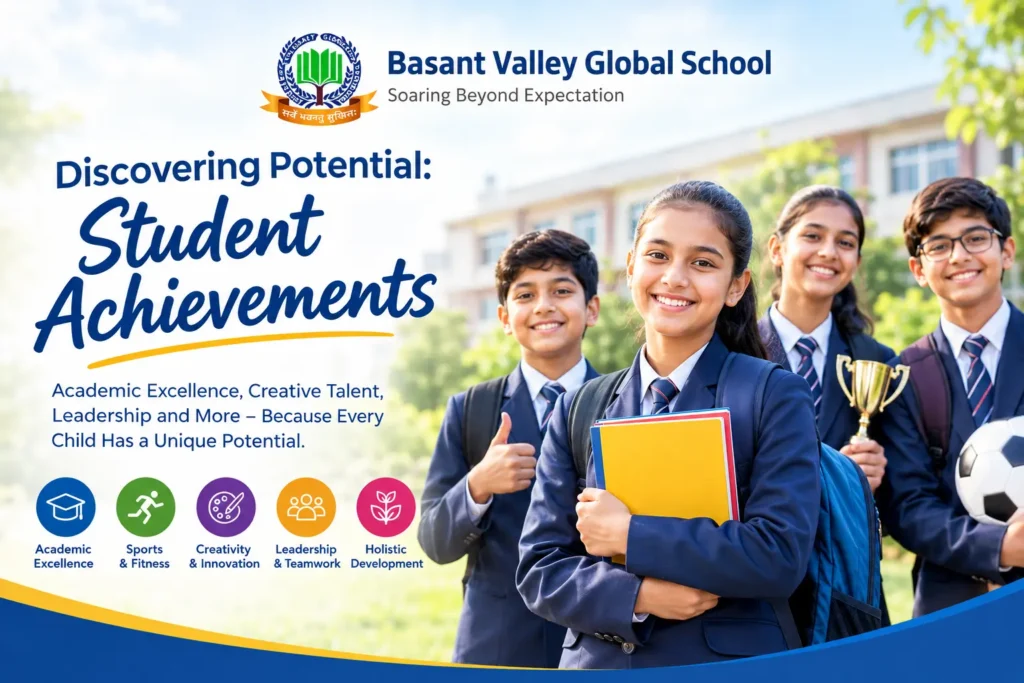
Student achievements reflect more than examination scores and report cards. They highlight a child’s progress in academics, sports, creative activities, leadership, communication, and personal development. At Basant Valley Global School, nurturing student talent and potential means encouraging every learner to explore their interests, develop confidence, and work towards meaningful goals. By creating opportunities for learning, participation, collaboration, and self-expression, schools can help students recognise their strengths and build the skills they need for the future. Celebrating student achievements also motivates children to keep learning, overcome challenges, and take pride in their progress.
What Are Student Achievements?
Student achievements are the accomplishments, improvements, and milestones children reach throughout their educational journey. These achievements can be academic, extracurricular, social, creative, or personal. They demonstrate how students apply their knowledge, develop new abilities, and grow as individuals.
Examples of student achievements include:
- Achieving improved academic results or mastering a challenging subject.
- Winning or participating in sports competitions.
- Receiving recognition in art, music, dance, or other creative activities.
- Taking part in science exhibitions, quizzes, debates, and school projects.
- Demonstrating leadership, teamwork, and responsibility.
- Showing improvement in communication, confidence, and problem-solving.
- Helping classmates, participating in community initiatives, and displaying kindness.
Every child develops at a different pace. Therefore, recognising effort, progress, and perseverance alongside awards and high scores helps create a more inclusive learning environment.
Why Student Achievements Matter in School Education
Student achievements play an important role in building a positive attitude towards education. When children see their efforts recognised, they are more likely to remain motivated, participate actively, and develop confidence in their abilities.
-
Builds Confidence and Self-Esteem
Recognition helps students understand that their hard work has value. Whether a child performs well in a classroom activity or completes a difficult assignment independently, celebrating the achievement can strengthen self-belief.
Confident students are often more willing to ask questions, share ideas, participate in discussions, and try unfamiliar activities. This confidence can support their growth both inside and outside the classroom.
-
Encourages Academic Excellence
Academic excellence is not limited to achieving the highest marks. It also includes understanding concepts, developing curiosity, applying knowledge, and consistently improving learning habits.
Teachers and parents can support academic progress by setting realistic goals, identifying areas for improvement, and encouraging regular practice. Recognising small milestones can help students stay focused on their educational objectives.
-
Develops Leadership and Teamwork
School activities give children opportunities to work together, share responsibilities, and solve problems. Group assignments, sports teams, cultural programmes, and student leadership roles can help learners understand the value of cooperation.
These experiences teach students to listen to different perspectives, respect others, manage responsibilities, and work towards shared goals.
-
Promotes Creativity and Critical Thinking
Children often discover their abilities when they are encouraged to explore different interests. Art, music, storytelling, robotics, science projects, and debates can help students express ideas and approach challenges creatively.
Such experiences also encourage critical thinking, experimentation, and independent decision-making—skills that remain valuable throughout life.
-
Encourages Resilience and a Growth Mindset
Not every attempt results in a prize or immediate success. Learning from mistakes, accepting feedback, and trying again are important achievements in themselves.
When schools encourage a growth mindset, students learn that skills can improve through effort, practice, and guidance. This approach helps them face challenges with greater patience and determination.
How Schools Can Recognise and Encourage Student Achievements
A supportive school environment gives students opportunities to demonstrate their abilities in different ways. Recognition should be meaningful, fair, and appropriate to each learner’s stage of development.
Celebrate Academic Progress
Schools can acknowledge improvements in subject understanding, reading, writing, mathematics, research, and classroom participation. Recognising consistent effort alongside outstanding results helps more students feel included.
Teachers can also provide constructive feedback that explains what a student has done well and what steps could help them improve further.
Provide Opportunities Beyond the Classroom
Extracurricular activities help children explore interests that may not be fully expressed through conventional examinations.
Useful opportunities include:
- Sports, athletics, and physical education.
- Art, music, dance, and drama.
- Public speaking, debates, and creative writing.
- Science fairs, exhibitions, and educational projects.
- Environmental awareness and community service.
- Team-based competitions and leadership activities.
Participation can help students discover hidden abilities and develop skills that complement their academic learning.
Recognise Effort, Improvement, and Participation
Awards can be motivating, but recognition should not be limited to students who finish first. A child who improves their reading skills, becomes more confident speaking in public, or learns to work effectively in a team has made meaningful progress.
Schools can recognise such milestones through certificates, classroom appreciation, displays of student work, constructive feedback, and opportunities to share learning experiences.
Build Strong Partnerships with Parents
Parents play an important role in supporting student achievements. Regular communication between families and teachers helps identify a child’s interests, strengths, challenges, and learning needs.
At home, parents can encourage children by asking about their experiences, celebrating progress, providing time for practice, and avoiding unnecessary comparisons with other students. A supportive approach helps children focus on personal growth rather than fear of failure.
Student Achievements and Holistic Student Development
Holistic student development focuses on nurturing the academic, emotional, physical, creative, and social aspects of a child’s personality. It recognises that education should prepare students not only for examinations but also for the challenges and opportunities of everyday life.
At Basant Valley Global School, the broader goal of education can be understood through the importance of helping students explore their abilities, develop positive habits, and become responsible individuals. Meaningful student achievements can reflect progress in several areas.
Academic Development
Students strengthen their knowledge through classroom learning, independent study, practical activities, and regular feedback. These experiences encourage curiosity, subject understanding, and a lifelong interest in learning.
Social and Emotional Development
Learning to communicate respectfully, manage emotions, show empathy, and cooperate with others contributes to a child’s overall growth. These abilities help students build positive relationships and navigate challenges constructively.
Physical Development
Sports and physical activities encourage fitness, discipline, coordination, teamwork, and perseverance. Participation also teaches students how to handle both success and disappointment in a healthy way.
Creative Development
Creative activities provide opportunities for imagination, experimentation, and self-expression. Students may discover interests in music, visual arts, writing, performing arts, or innovative projects.
A balanced approach to education allows children to explore these different dimensions and discover the areas in which they can thrive.
Inspiring Student Success Stories: Every Milestone Matters
Student success stories can inspire other learners by showing how dedication, consistent effort, and the right guidance contribute to progress. These stories do not always need to feature national-level awards or exceptional examination results.
For example, a student who was once hesitant to speak in class may gradually develop confidence through presentations and debates. Another learner may improve in mathematics by practising regularly and seeking help when concepts seem difficult. A student participating in a team project may discover leadership skills by coordinating tasks and listening to classmates.
These examples illustrate how student achievements can develop over time through practice, encouragement, and perseverance.
Schools can share authentic student success stories through newsletters, school websites, assemblies, achievement boards, and parent communication. Such recognition should accurately represent students’ accomplishments and respect their privacy.
By highlighting different forms of success, schools can encourage children to appreciate their own strengths while respecting the achievements of others.
How Parents Can Support Student Talent and Potential
Parents are important partners in helping children discover their interests and achieve their goals. A positive home environment can reinforce the values and learning habits developed at school.
Here are some practical ways parents can support their children:
- Identify individual interests: Observe which activities naturally engage your child, whether academics, sports, technology, music, or creative work.
- Set realistic goals: Help children break larger objectives into manageable steps and celebrate progress along the way.
- Encourage consistency: Regular practice and healthy routines can be more valuable than last-minute preparation.
- Appreciate effort: Recognise persistence, curiosity, responsibility, and improvement instead of focusing only on marks.
- Allow room for mistakes: Help children view setbacks as opportunities to learn rather than reasons to give up.
- Maintain communication with teachers: Discuss progress and areas where additional support may be useful.
- Support a healthy balance: Make time for sleep, physical activity, hobbies, friendships, and relaxation alongside academic responsibilities.
Every child has a different combination of strengths and interests. Patient guidance can help children build confidence and pursue their goals without unnecessary pressure.
The Role of Basant Valley Global School in Nurturing Student Growth
A school’s learning environment can make a meaningful difference in how students discover and develop their abilities. Supportive teaching, engaging learning experiences, constructive feedback, and opportunities for participation can help learners become more confident and independent.
For families exploring educational opportunities, Basant Valley Global School represents the school context in which academic learning and student development can be discussed together. Parents can learn more about the school’s curriculum, co-curricular opportunities, teaching approach, and student achievement programmes by contacting the school or consulting its official website.
When evaluating a school, parents may wish to consider questions such as:
- Does the school encourage participation beyond academics?
- Are students given opportunities to explore different interests?
- How does the school recognise individual progress?
- Are students encouraged to collaborate and express their ideas?
- How do teachers communicate progress and areas for improvement to parents?
- What opportunities are available for developing leadership and life skills?
These questions can help families understand whether a school’s approach aligns with their child’s learning needs and interests.
The ultimate purpose of celebrating student achievements is not simply to create a record of awards. It is to recognise growth, encourage curiosity, and help children develop the confidence to pursue new challenges.
Conclusion: Celebrating Student Achievements and Every Child’s Potential
Student achievements are an important part of a child’s educational journey because they reflect progress, dedication, confidence, and the development of new skills. From academic excellence and sporting accomplishments to creativity, teamwork, and personal growth, every meaningful milestone deserves recognition.
Through a supportive learning environment, constructive encouragement, and opportunities to explore different interests, schools and families can help children discover their abilities and work towards their goals.
At Basant Valley Global School, the broader conversation around student development highlights the value of recognising each learner’s individual potential. By celebrating effort as well as accomplishment, encouraging holistic student development, and sharing authentic student success stories, the school community can help inspire children to keep learning, growing, and striving for excellence.
Frequently Asked Questions (FAQs)
-
What are student achievements?
Student achievements are accomplishments or improvements in academics, sports, creative activities, leadership, communication, and personal development. They include examination results, competition participation, improved skills, teamwork, and progress towards individual learning goals.
-
Why are student achievements important?
Student achievements help build confidence, motivation, resilience, and a positive attitude towards learning. Recognising progress can encourage children to develop their skills, set goals, and continue improving academically and personally.
-
How can schools encourage student achievements?
Schools can encourage student achievements by providing engaging learning experiences, organising extracurricular activities, offering constructive feedback, recognising individual progress, and creating opportunities for students to participate in competitions, projects, and leadership activities.
-
What is the relationship between academic excellence and holistic student development?
Academic excellence focuses on learning, subject knowledge, and educational progress, while holistic student development includes academic, physical, social, emotional, and creative growth. Both contribute to preparing students for future educational and personal challenges.
-
How can parents help children achieve their potential?
Parents can support children by identifying their interests, setting realistic goals, encouraging regular practice, appreciating effort, communicating with teachers, and providing a balanced environment where children feel comfortable learning from mistakes.